
What It Costs to Harvest Corn and Soybeans Too Dry
Somebody asked this in a farming group this fall and thirty-six people answered. Nobody gave him a number.
His question was simple. Warm weather, corn drying fast, he's shutting the dryer down and hauling straight to the bin. If most of the crop comes off one to two points under ideal moisture, how many bushels does that cost him?
There's an answer, and it's worth knowing — even though there's nothing you can do about it once the grain is in the bin.
Short answer: for corn, every point under your buyer's base — usually 15% or 15.5% — costs about 1.1 to 1.2% of your bushels. Soybeans run the same math from a 13% base.
Why dry corn costs you bushels
A bushel of corn is 56 pounds. Not 56 pounds of dry matter — 56 pounds of corn, water included.
That's the whole thing. Deliver corn at 15.5% moisture and roughly 8.7 of every 56 pounds is water — and you get paid for it. Deliver the same grain at 13.5% and less of that weight is water, so it weighs less, so there are fewer bushels to sell.
Nobody docks you. There's no line on the settlement. You simply have less.
Take one load. A thousand bushels at 15.5% is 56,000 pounds, of which 47,320 is dry matter. Bring that same 47,320 pounds of dry matter in at 13.5% and it weighs 54,705 pounds — 976.88 bushels. You're 23 bushels short on one truck, and the grain is identical.
The arithmetic
The formula extension services use:
loss % = 1 − (100 − starting moisture) ÷ (100 − ending moisture)
Run from a 15.5% base:
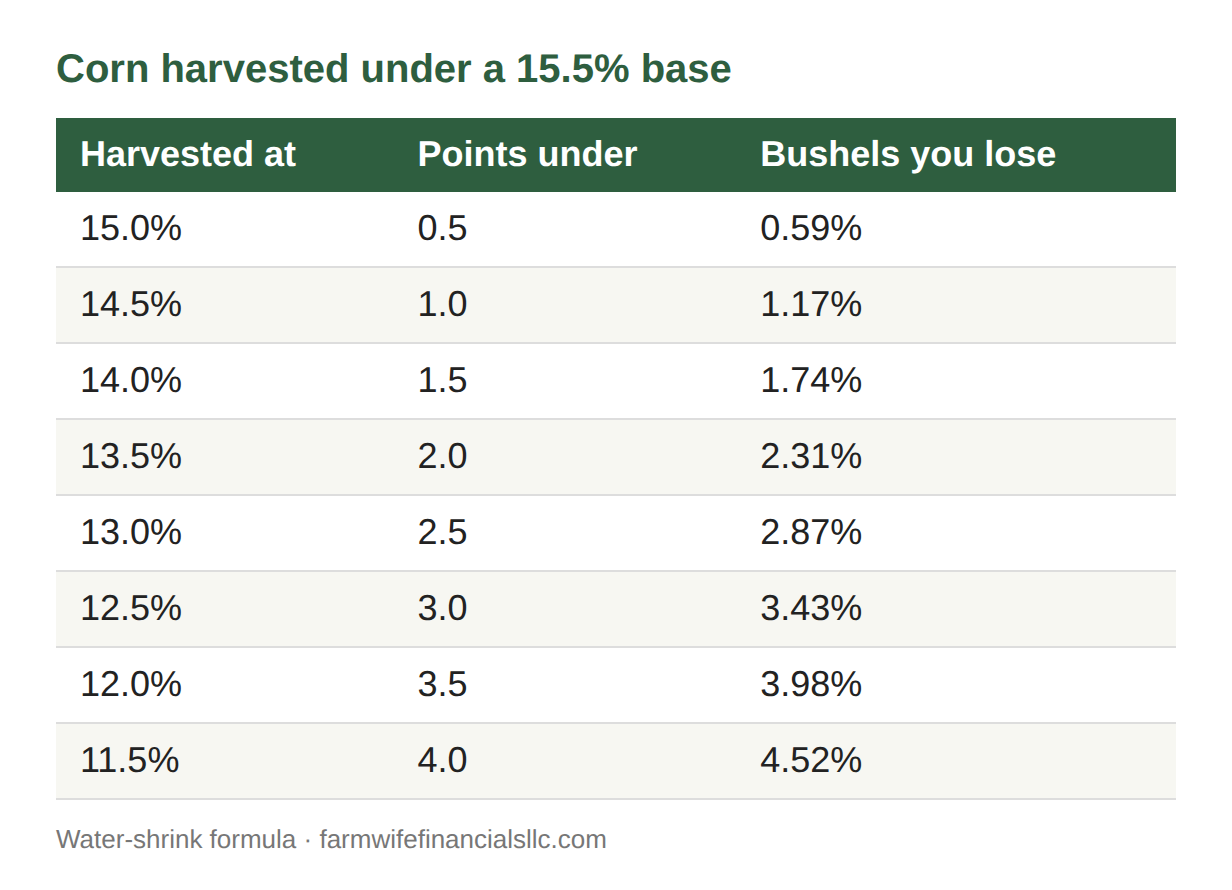
The What Moisture Costs tab in our Grain Inventory & Moisture Shrink Calculator runs this table on your own base, price and truck size. So the man in the group, one to two points under, is looking at 1.2% to 2.3% of his crop.
Check the base your buyer actually uses. Some settle at 15.0% rather than 15.5%, which shifts the numbers a little — at a 15.0% base, harvesting at 13.0% costs 2.30% instead of 2.87%.
What that's worth
At 210 bushels an acre, two points under base:
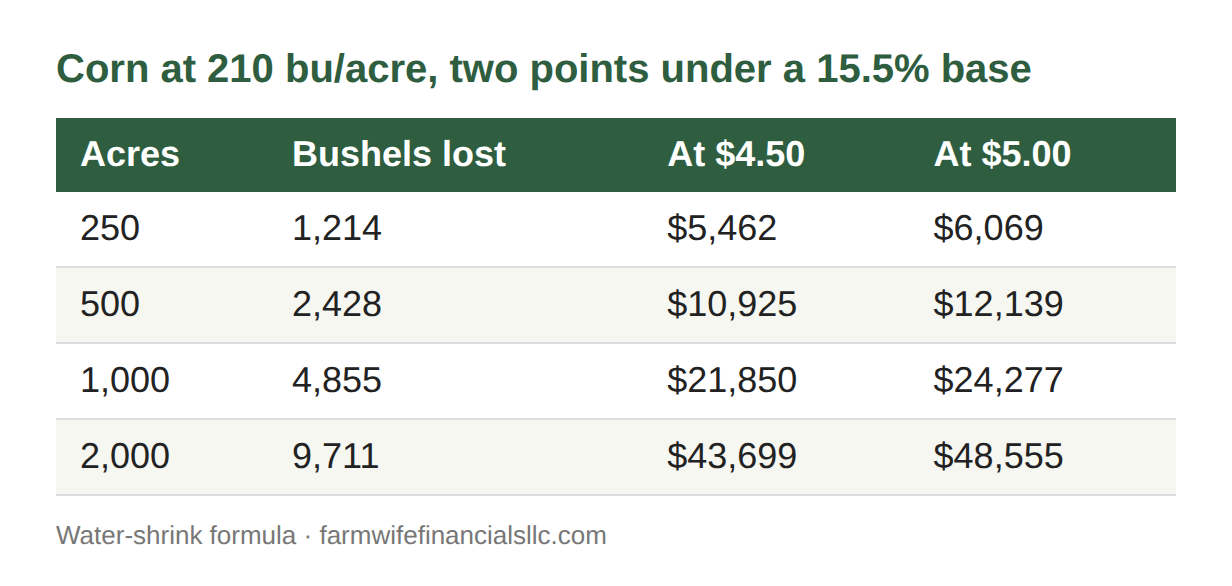
A thousand acres two points dry is about five semi loads of corn that never existed.
Soybeans: same math, lower base
Beans run into this a lot. The market standard is 13%, and beans that dry down in the field often come in at 10% or lower.
Same formula, from a 13% base:
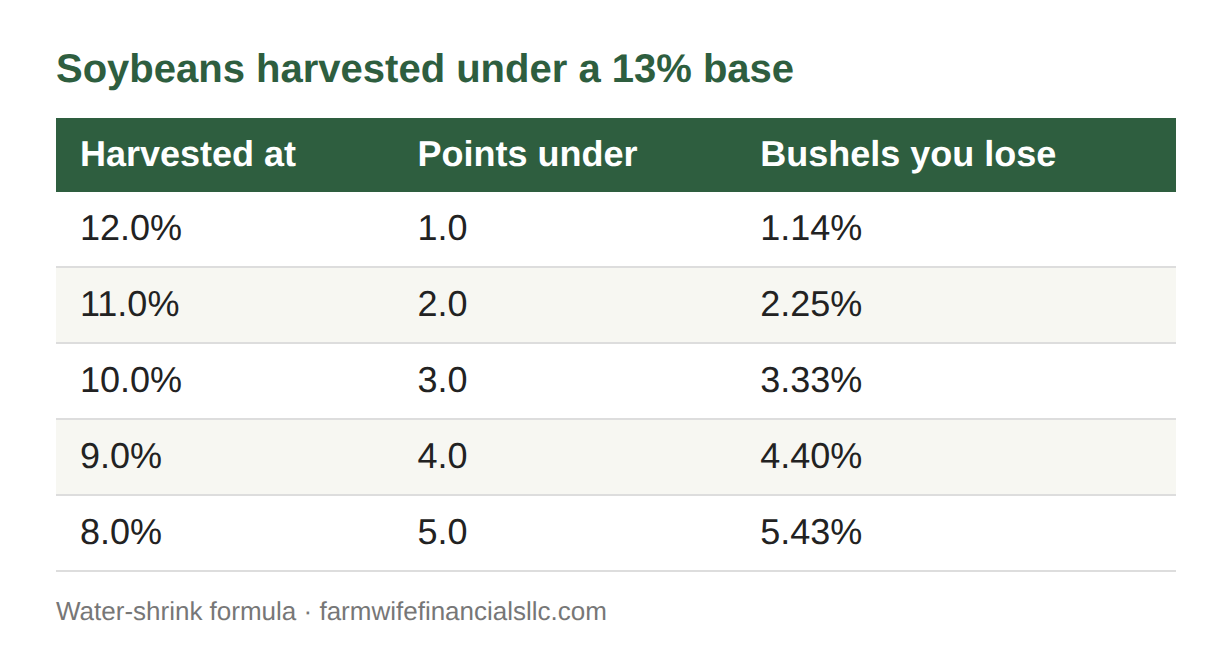
A bushel of beans at 13% is 60 pounds. The same beans at 10% weigh 58. On 1,000 acres of 60-bushel beans, three points under is 2,000 bushels.
The part that stings
You don't get it back.
Most buyers charge you when grain comes in wet — a shrink on your bushels for the water they'll remove plus a handling allowance, a discount, or both. But there's no reverse. Bring corn in at 13% and nobody credits you for the water that isn't there.
Before you decide to harvest wetter
This is a real cost, and it's bigger than most people think. It is not, on its own, a reason to leave corn standing.
Waiting for moisture costs you things this arithmetic doesn't capture. Stalk quality goes backwards. Ear drop and lodging risk climb. A wind event in late October can take more in an afternoon than four points of shrink takes all season. And if you're drying, propane and dryer shrink eat into whatever you'd gain.
Beans have their own version of this. Dry beans shatter more easily at the header, and Nebraska's analysis notes that can make harvesting drier beans the more costly side.
The man in the group wasn't asking whether to wait. He'd already shut the dryer down and was taking the corn as it came. What he wanted was the size of what he was giving up.
That's all this arithmetic is for. It tells you what happened. Weighing it against field loss, dryer cost, and the weather in front of you is a different decision, and it's yours.
Where the numbers come from
Every figure here comes from the standard water-shrink formula, checked against published worked examples from South Dakota State, Pioneer, and Iowa State. SDSU's 25%-to-15.5% example gives 11.24%; the formula gives 11.24%. Iowa State's 56,000-pound load at 20.5% dried to 15% comes out at 52,376 pounds; the formula agrees to the pound. Nebraska's soybean example — a 60-pound bushel at 13% weighing 58 pounds at 10% — matches it too. The formula is above, and it fits in a calculator.
This same table is the What Moisture Costs tab in our Grain Inventory & Moisture Shrink Calculator. Pick the crop, set your cash price and truck size, and it shows what a load gives up below base, in bushels and dollars — and what a wet load costs at two buyers and at your own dryer. The rest of the file is where you log each load, with the shrink and dock it calculates set next to what your settlement charged. It's in the store.
Farm Wife Financials LLC builds Excel templates for farm record-keeping. This article is general information about how grain weight and moisture relate — not advice on harvest timing, marketing, or any decision specific to your operation. Talk to your agronomist and your buyer about your own crop.